|
Health
Page 1 - Genetic Disorders "Genetic
diseases are nature's "knockout" experiments,
occurring spontaneously in all species." John
C. Fyfe
our
other health pages are: Virus
Testing Vaccinations
Parasites
about breeding
gestation
time schedule books about
health Dear Maine
Coon friends, this
is the first health page - we still work on it and hope to be
able to present you more pages about this important theme soon.
On this page we start with Genetik
Disorders. If you need further
informations you can find some helpful pages following the
Links. All our breeding cats
older than 1 year are checked for HCM, HD, PL and
PKD.
Unfortunately there is no SMA test yet. We would appriciate if
all breeders would check there breeding cats. Nothing is more
important as the health of our beloved gentle giants. TO
TEST IS THE BEST...we hope you
agree with us
Hypertrophic Cardiomyopathy
(HCM)
Hypertrophic
cardiomyopathy (generally referred to as "HCM") is a
heart disease that affects domestic cats in general---including
pedigreed and non-pedigreed cats. HCM is a genetic disease that
is inherited as an autosomal dominant trait. In humans, HCM is
caused by mutations in genes that code for proteins that are
responsible for contraction of the heart muscle. A reduction in
the amount of a protein called myomesin---one of the proteins
needed for normal heart muscle contraction---has been identified
in Maine Coon cats with HCM.
Hypertrophic cardiomyopathy is a disorder in which the heart
muscle becomes abnormally thick (in case of DCM it become to
thin) and decreases the effectiveness
of the heart, eventually resulting in heart failure and/or
embolism (blood clots). It can be diagnosed by echocardiography
(cardiac ultrasound examination) which should be performed and
interpreted by a board-certified veterinary cardiologist. Some
affected cats and kittens have an audible heart murmur, while
others do not, so the absence of a heart murmur is not
definitive evidence that a kitten or cat is normal. It is
recommended that an initial echocardiogram be performed before a
cat is bred for the first time, and that another one be
performed at approximately two years of age. This disease is
treatable, but can result in sudden death in older kittens and
young adult cats. Sudden death in breeding cats or kittens
should be investigated by necropsy (post-mortem examination)
performed by either your regular veterinarian or a veterinary
pathologist.
Although HCM is an inherited disease, evidence of HCM is not
present at birth. Instead, this disease develops over time in
affected individuals. The progression and severity of HCM can
differ widely, even among closely related cats. These variations
are due to the unique characteristics of autosomal dominant
inheritance known as "variable expression" and "incomplete
penetrance." Some of the variability in expression is due
to sex differences. In general, males develop the disease at an
earlier age and the disease usually progresses more rapidly in
males. Not all of the variability is due to sex differences,
however. For example, a cat may exhibit severe disease at an
early age, while either of his or her parents may exhibit very
mild and slow progression of the disease. Although not proven,
some cats can apparently continue to have no echocardiographic
evidence of HCM at five years of age or older, even though they
possess the mutant gene that causes HCM.
It is important to understand that HCM is
a genetic disease and that it is inherited as an autosomal
dominant trait. It is also important to understand the
characteristics of autosomal dominance. With an autosomal
dominant trait, most commonly one parent has a mutation in a
gene that codes for a protein that contributes to the structure
of some portion of a cell. When only one parent is affected, 50%
of the protein that results from the mutated gene is abnormal
and usually dysfunctional. Cells, like buildings, usually cannot
function when only 50% of their support structure is normal.
Consequently, the cell becomes dysfunctional. In contrast, many
diseases inherited as autosomal recessive traits have a mutation
in a gene that codes for an enzyme. With most enzymes, enough
reserve exists that only 50% of the enzyme is enough for the
system involved to function normally. However, when 100% of the
enzyme is dysfunctional, disease is produced. In this situation,
an affected individual must inherit an abnormal gene from both
parents to exhibit the disease. Since HCM is inherited as an
autosomal dominant trait, an affected cat need only have one
parent with the HCM mutation. This affected parent can continue
to produce affected offspring though it may show no outward
signs of the disease.
Cats that show no outward (i.e., clinical) signs of HCM may have
an apparently normal heart on an echocardiogram, a heart with
only subtle changes on an echocardiogram, or a heart with
obvious echocardiographic changes. Only cats with severe disease
develop clinical signs related to heart failure (e.g., an
increased breathing rate, labored breathing). Because some cats
have only subtle changes or changes that cannot be distinguished
from normal on an echocardiogram, not all cats with the mutation
responsible for HCM in Maine Coon cats can be identified using
echocardiography. Consequently, it will be impossible to
completely eliminate HCM from the feline population using this
modality. However, there is little doubt that echocardiographic
screening can reduce the incidence of the disease in Maine Coon
cats and that it should be used for this purpose. Proactive and
concerned Maine Coon breeders are at the forefront of the battle
against this disease, as it is known to exist in some Maine
Coons.
It is understood that each individual breeder is responsible for
his or her own decisions regarding breeding practices and,
therefore, each breeder is equally responsible for the health
and well-being of every kitten produced in his or her cattery.
However, due to the insidiousness of HCM and its lethal impact
on affected animals, we recommend that every breeder have a plan
for screening each of the cats in his or her breeding program.
HCM screening should be done by a Board Certified Veterinary
Cardiologist or other equally qualified, trained, and
experienced veterinary professional. Early stages of HCM are
usually not detectable via ECG or auscultation. At minimum, HCM
screening should include a thorough physical exam and a
two-dimensional cardiac ultrasound (echocardiogram). Additional
tests such as color flow Doppler ultrasonography may be done at
the discretion of the breeder and/or veterinary professional.
Eliminating HCM from our
Maine Coons is of utmost importance. We are so lucky to have Dr.
Kittleson working with Maine Coon breeders. If anyone would like
to help fund Dr. Kittleson's work, one way to do this is with a
check payable to U.C. Regents, marked in the notes/memo line "CCAH-Dr.Kittleson"
and sent to:
Center for Companion Animal Health
C/O VM-Development Office
School of Veterinary Medicine
U.C. Davis
Davis, CA 95616
Send a note stating
that you are donating to the Center for Companion Animal
Health for Dr. Kittleson's work on HCM in Maine Coons.
It will go directly for his work. Unlike donations to a
foundation such as WINN or TIFF, you do not need to wait for a
certain amount to be accumulatedor for the directors of the
foundation to grant the funds. Each check is processed
individually. The most the Center will deduct is 5% and
they do not always deduct anything to cover their
administrative expenses so you know that 95-100% of your
donation is going to Dr. Kittleson's research. This is
his preferred mode of donation. Just imagine
what we could do for his study if we ALL donated just $25 each
-- today?
Feline
Hypertrophic Cardiomyopathy
|
This
Website contains information about the hereditability,
diagnosis, treatment, and prognosis of feline Hypertrophie
Cardiomyopathy.
|
The
Newmanveterianry Feline HCM Page
RCM
Quote:
"Restrictive cardiomyopathy occurs
when ventricular diastolic stretch (ie compliance) is impaired
by endocardial, subendocardial, or myocardial fibrosis or an
infiltrative disease, resulting in an increased diastolic
pressure for any given diastolic volume."
(Kittleson and Kienle, Small Animal
Cardiovascular Medicine, page 364, copyright 1998)
About RCM. There isn't
much information about it since it is so rare in cats. And when
it occurs in cats it usually affects older cats. It is not
likely to be hereditary, and it can occur as a result of an
infection. It's a difficult disease also because it is virtually
impossible to notice with an ultrasound, and usually the first
symptom is the cat's death
Hip
Displasia (HD) Hip
Dysplasia is defined as an abnormality of development of the hip
joint, affecting one or both hip joints. Hip dysplasia is an
inherited trait involving multiple gene pairs. In order for an
animal to have hip dysplasia both parents are either affected by
or carriers of the disease. HD is not congenital (meaning an
animal is not born with it); the condition develops over time
from instability in the hip joint. This instability results from
an improper fit of the femoral head (ball-like structure on the
end of the femur) into the acetabulum (hip socket). This
instability, or "joint laxity", results in abnormal
weight bearing within the hip joint. From this, secondary
changes and remodeling occur in an effort to stabilize the joint
or avoid bone-on-bone contact. When cartilage disintegrates from
abnormal wear, the femoral head and acetabulum rub together with
every step, often causing osteoarthritis. At
present, hip dysplasia is best identified by x-rays of the hips.
Hip dysplasia is a developmental abnormality of the hip joint.
Preliminary hip x-rays should be taken at approximately 8-12
months of age, before a cat is first used for breeding. Final
hip x-rays should be taken at 24 months of age. Certification by
the Orthopedic Foundation for Animals (OFA), a panel of
board-certified veterinary radiologists, is recommended. Copies
of the OFA (the
Orthopedic Foundation for Animals in Missouri) evaluation,
regardless of the result, should also be sent to the cat's
breeder. Only cats with hips graded fair or better (good,
excellent) should be used for breeding. Cats which have been
identified as having any grade of hip dysplasia must not be used
for breeding. It is possible for a cat to have severe HD yet be
out of parents with Good or Excellent hip ratings. It is also
possible to have cats with good ratings from parents who are
Fair and Borderline. HD is a curious polygenetic situation.
Patellar
Luxation (PL) Luxation
of the patellae. No ocvious defects of bone structure appear to
be responsible for the luxation. Occasional luxation may not
lead to lameness, but recurrent luxation cancause lameless. The
breed incidence suggests a genetic influence but the mode of
inheritance is unknown. The proportion of affected animals is
less than 25% on the basis of assortment of a recessive gene.
Either a proportion of affected individuals have escaped
detection or the anomaly has a polygenetic threshold character.
The luxation is particulary severe by 1-2 years of age.
Spinal
Muscular Artrophy (SMA) Spinal
muscular atrophy is a newly-identified disease in Maine Coon
cats which may go back to some of our more popular foundation
cats. At this point, we know it is an autosomal recessive
disease. The mutated, defective gene must be inherited from both
parents before the disease is seen; carrier cats appear to be
normal. Any cat producing an affected animal is an obligate
carrier.
Affected animals experience a loss of spinal motor neurons to
the large muscle groups, particularly in the rear legs.
Subsequently, the muscles atrophy from lack of stimulation. The
animals so affected develop a swayed gait, more labored
breathing, and tremble at times. Symptoms begin to appear at
three to four months of age, when kittens rest more quickly from
play than normal siblings, and develop difficulty in jumping or
trouble landing on their feet when jumping from a chair or sofa.
There is a fairly rapid progression of loss of function, then
the cat appears to plateau or loose function more slowly for a
period of time. John
C. Fyfe discribes this disease as follows... Spinal
muscular atrophy (SMA) is the most common recessive disorder
lethal to infants and the second most common pediatric
neuromuscular disorder.. SMA is a lower motor neuron disorder
which results in denervation atrophy of skeletal muscle. In
humans, most cases are due to mutations of the survival of motor
neuron gene (SMN), but the disorder has wide phenotypic
variability. The functions of SMN are not well defined, but
appear to include maintenance of RNA splicing. A mystery at
present is why motor neurons are particularly sensitive to loss
of a universal cell activity. We are presently investigating a
mild form of spinal muscular atrophy occurring as an autosomal
recessive trait in a family of cats. Preliminary results suggest
that the SMN locus is not altered in the affected cats. Other
candidate loci are currently under investigation.In our opinion,
prevention through carrier detection is the only real solution
to the problem of genetic disease in companion animal
populations.
Polycystic
Kidney Disease (PKD)
Polycystic
Kidney Disease is an inherited kidney disease that has been
found in Persian/Exotic cats. Feline Polycystic Kidney Disease (PKD)
has been reported sporadically in the literature since 1967, but
actual study into this renal disease did not begin until 1990.
In1990 an affected female Persian was referred to the Ohio State
University teaching hospital with symptoms of renal failure.
Offspring of this female were used to start a colony and begin
research into this condition.
|
|
|
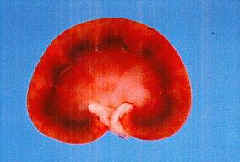
above: cat
kidney of healthy cat |
|
|
|
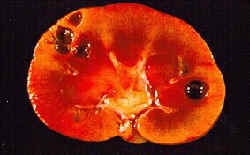
above: kidney of
a six weeks old kitten with PKD |
|
|
|
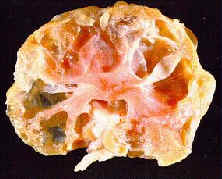
above: kidney of
an adult cat with end-stage of PKD |
PKD
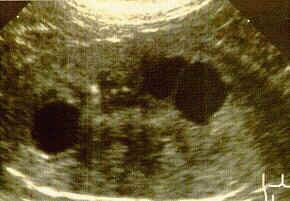
is most easily diagnosed by ultrasound, which can identify the
disease very early in its course. All that is required is a
mid-ventral abdominal area hair-clip and a short time period for
imaging to detect the possible presence of cysts. It takes a few
minutes, with little or no sedation needed. It is very
important that experienced personnel and proper equipment
perform the ultrasound! When so, ultrasound diagnosis is 98%
accurate after approximately 10 months of age. The frequency of
the transducer has to be 7,5 MHz - 10 MHz, with a greyscale of
256. The higher frequency, the better details. A
DNA-test for ADPKD in cats is not available at this time.
|
|
| above:
ultrasound picture of an 8 weeks old cat with 3 cysts |
|

|
|
above:
ultrasound picture of an adult cat (positive for PKD)
with end-stage PKD |
Polycystic
Kidney Disease is a slowly progressive disease. It clinically
shows up later in life (late onset), with enlarged kidneys and
kidney dysfunction on average at seven years of age. The
condition is inherited and cysts are present from birth. The
size of cysts can vary from less than one millimetre to several
centimetres, with older animals having larger and more numerous
cysts. Problems occur when these cysts start to grow and
progressively enlarge the kidney, reducing the kidneys' ability
to function properly. The ultimate end is kidney failure.
Some
of the clinical signs are depression, lack of or reduced
appetite, excessive thirst, excessive urination and weight loss.
There is a marked variability in how quickly individual cats
succumb, with the possibility of the symptoms of PKD developing
late enough in life that the cat can die of other causes before
kidney failure. However, kidney failure is certain when and if
the cysts grow and cause problems.
How
does a cat get
PKD?
Dr. David Biller
from the University Of Kansas finished his studies on PKD
and made them public. They show that PKD is inherited in an autosomal
dominant way. You can find the test results at "Journal of Heredity" 1996;87:1-5.
PKD is an "autosomal dominante" gene which shows
up as soon as it has been inherited, also if the PKD gene comes
only from on parent. This means that a PKD negativ cat is also
genetically PKD negative. If a cat is PKD positive we have to
make the difference if it is heterozygous (the gene has been
inherited by one parent only or homozygous which means that the
cat to the gene from both parents.
The
chart below show simple "Mendelsche Genetic"
to show you how PKD is inherited.

PKD
negative cat = xx, heterozygous PKD positive cat =
Xx , homozygous PKD positive cat = XX
The
Feline PKD Home Page
This
page contains information about Polycystic
Kidney Disease. While most of the
research on this disease has been done on Persian cats,
there are documented cases in Maine Coon cats.
Virus Testing
Vaccinations Parasites




set by Ines Fleischer,the
kitten of this set is Bonfires Gizmo, wallpaper by Jane
|